Health Promoting Experiences of Storytellers: A Meta-Synthesis of Qualitative Studies
Digital storytelling in healthcare is often described as a creative tool, but the deeper value is how it reshapes meaning. In this conversation, midwife and PhD candidate Jonathan Dominguez Hernandez explains why he turned to digital storytelling research to better understand fear of childbirth and other vulnerable health experiences. He traces his path from pediatric nursing in Spain to midwifery training in the UK, then into academia in Switzerland, where he observes how fear, stigma, and professional culture influence health.
A major focus of the episode is Jonathan’s meta-synthesis of qualitative studies on group-based digital storytelling workshops and the impact on the storyteller. He explains why qualitative evidence matters when you want to measure nuanced outcomes like confidence, belonging, or self-understanding. Using systematic searching, quality appraisal, and framework analysis, he synthesizes what participants say about the process and then assesses confidence in those findings. The review narrows to studies that explicitly address the storyteller’s experience rather than only using stories as data about an illness. The episode makes the research accessible by walking through how themes are built from quotations, refined with collaborators to reduce bias, and elevated into higher-level patterns that can inform ethical facilitation in health and wellness settings.
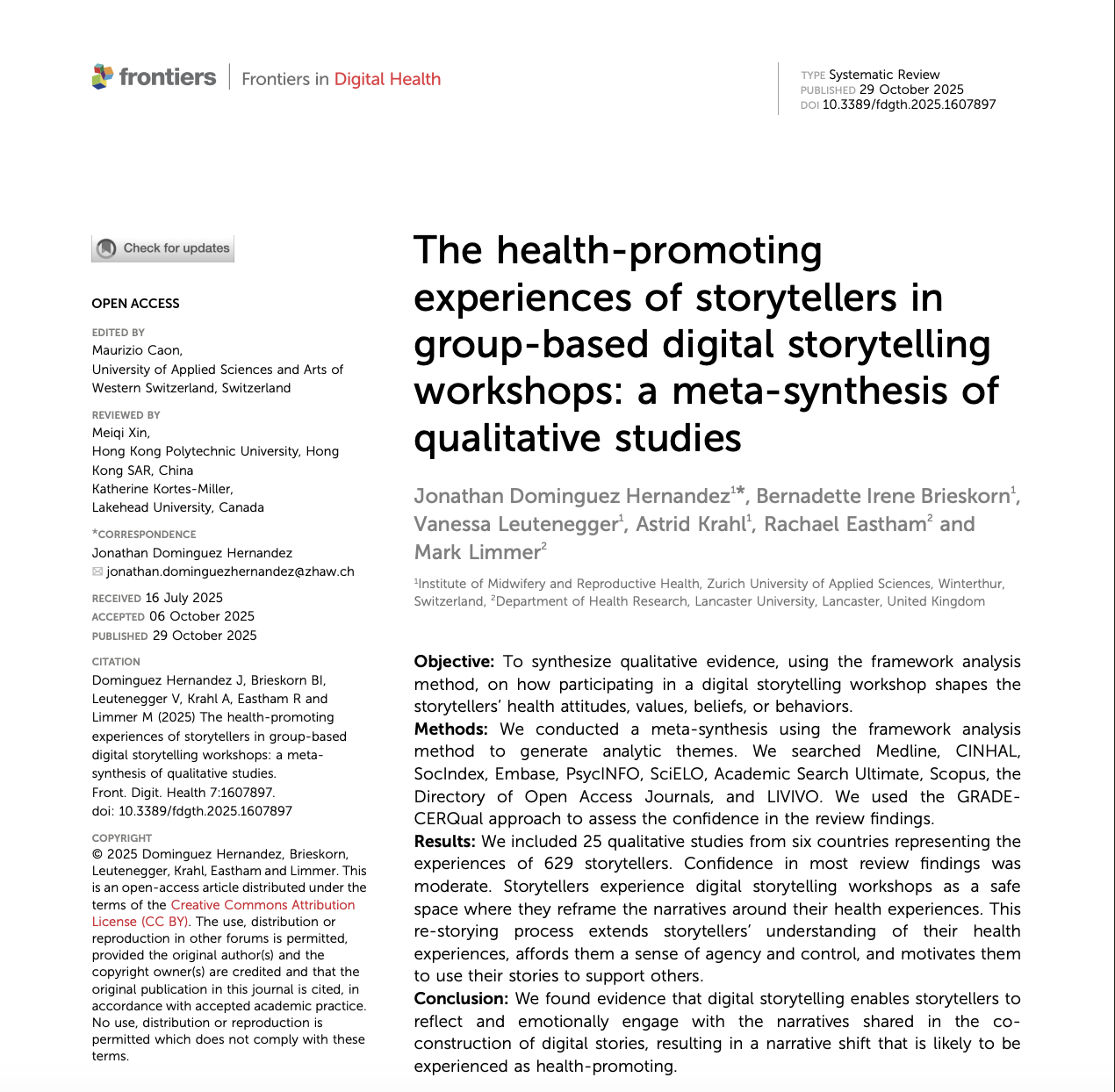
Read Jonathan’s work here
Four health-promoting themes anchor the discussion. First, people “re-story” or re-author lived experience by revising how they understand events and integrating what they learn from others’ stories. Second, storytelling enables emotional processing because the method forces recall, embodiment, and naming of feelings, which can be intense but manageable with skilled facilitation. Third, a ripple effect emerges in groups when empathy turns into compassion and mutual support, building a sense of community for people living with similar conditions. Fourth, participants often gain agency, treating the finished video as an artifact they can revisit, share, or use for advocacy and counter-narratives. These outcomes matter for patient engagement, trauma-informed practice, and improving communication in healthcare.
Episode 53 Key Messages
2:47 From Nurse to Midwife
7:03 Discovering Digital Storytelling Training
8:36 Jonathan’s Personal Digital Story
11:13 One On One Workshops and Ethics
15:53 Why a Meta Synthesis
18:32 How the Review was Analyzed
22:52 Four Health Promoting Themes
27:31 Trauma, Safety, and Distress Protocols
37:51 Narratives Missing from Research
41:43 Narrative Analysis and Salutogenesis
The episode also highlights ethical realities, especially with trauma and perinatal mental health. Jonathan describes adapting from group workshops to one-on-one online creation due to recruitment barriers and privacy norms, plus the importance of consent, ownership, and distress protocols. He shares a powerful example where a survivor of sexual violence uses paintings instead of photos and rewrites her script to move from purely negative detail toward a more survivable meaning, including choices that restore control. Finally, he argues the next research step is studying the narratives themselves: the shared cultural storylines like victimhood, recovery, stoicism, “good mother,” and regaining control. His current PhD work uses dialogical narrative analysis and salutogenesis, focusing on sense of coherence: comprehensibility, meaningfulness, and manageability. For clinicians, educators, and facilitators, the takeaway is clear: stories do not only represent health experiences, they can actively shape them.
About Our Guest

Jonathan Dominguez Hernandez
is a researcher, educator, and midwife specializing in public health, Evidence-Based practice, and qualitative health research. He currently works as a researcher and lecturer at the Zurich University of Applied Sciences, where his work focuses on sex- and gender-sensitive healthcare, perinatal mental health, and inclusive approaches to care. With a background that combines clinical practice, public health, law, and education, Jonathan has worked across the UK, Austria, Switzerland, and Spain in both frontline maternity care and academic leadership roles. His research explores how narratives and digital storytelling can support health and wellbeing, and he is particularly interested in translating research into practical, compassionate, and Evidence-Based guidelines for clinical practice. Alongside teaching and research, he contributes to international guideline development and interdisciplinary projects aimed at improving maternal and perinatal health outcomes. Jonathan is currently completing a PhD in Public Health at Lancaster University, focusing on dialogical narrative analysis and health-promoting storytelling in women’s reproductive health.
Learn more about Jonathan’s work here.
About Co-Created
Co-Created is a podcast that takes you behind the scenes of digital storytelling. On each episode, host Kristy Wolfe dives into conversations with the storytellers and facilitators who bring digital stories to life.
If this particular conversation resonated with you, tell a friend or a colleague about Co-Created or share one of the digital stories we were talking about. You can find the stories here.
Co-Created is presented by Common Language DST, digital storytelling facilitation training for health and wellness changemakers and is supported by the team at Snack Labs.